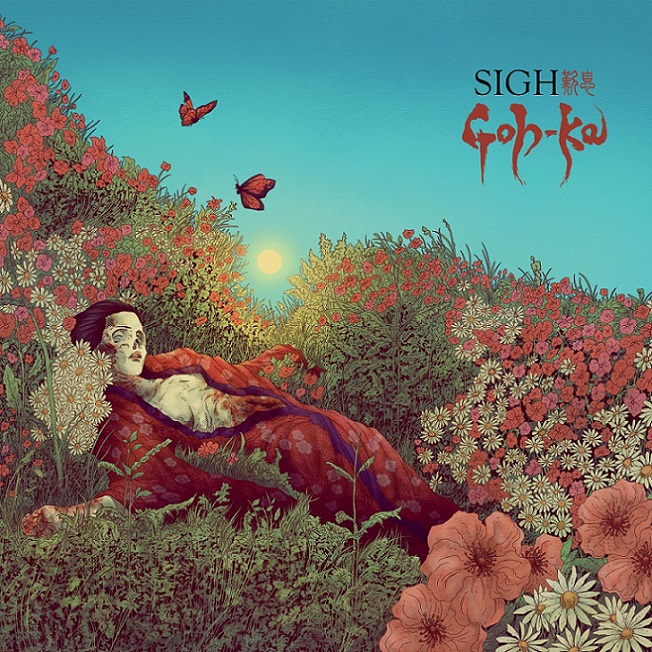
Sigh
Goh-Ka
Peaceville Records
To Be Released: September 4th, 2026
Rating: 9/10
–
1 – Kuso-shi 1, 2, and 3
2 – Jigoku-Zoshi 1: Unkamusho
3 – Anzenshokon
4 – Kuso-shi 4, 5, and 6
5 – Shoso
6 – Unputenpu
7 – Jinmenjushin
8 – Jigoku-Zoshi 2: Tokatsujigoku
9 – Kushukankyo
10 – Kuso-shi 7
11 – Kuso-shi 8 and 9 / Mettaijakujo
–
There is no doubt that the Japanese history of extreme music runs as far and deep as all others in the international scene. Going as far back as 1981, Loudness rang loud and true through conventional heavy metal compositions. 1982, perhaps even earlier, brought about groups like X Japan, who helped further the concept of ‘Visual Kei,’ adding a boisterous and captivating aesthetic element that made the bands into something that was greater than just records and tapes. Evil, which later became Sabbat, arrived in 1983, bringing about some of the earliest black metal in the island nation’s history. Key figures, such as Sabbat’s Gezol and his Evil Records label, helped establish a closed ecosystem for the rising extreme metal scene.
Having absorbed Venom, Celtic Frost, Bathory, as well as doom, thrash, hardcore and occult imagery – one drawn from the impossibly beautiful historical Japanese design – this noxious blend became the blood within the chalice of Japanese extreme metal. These early black metal attacks were chaotic, unique, and distinctively within their own national identity. Later bands would not assimilate to the Norwegian sound, opting to combine the myriads of sonic and visual influences into a lightning storm of sound and color, befitting what early bands had already established.
Sigh came about in 1990. With consistency nearly unmatched by all others, they produced album after album, beginning with Scorn Defeat in 1993, allowing the band to become living progenitors of the Japanese black metal scene. 1995’s Infidel Art showed the band’s competency when it came to dense and long-form arrangements, with most tracks lasting over eight minutes. The trio of Mirai Kawashima, Shinichi Ishikawa, and Satoshi Fujinami were a magnificent writing force with breathtaking synergy as composers.
1997’s Hail Horror Hail is where the band began to blossom into a chaotic and avant-garde trinity of pure creativity. More expansive, atmospheric, and sprawling strains of sound began to form together in genesis. As releases came to be, Sigh moved into a creative territory most were not prepared to traverse. Albums such as Scenario IV: Dread Dreams, Imaginary Sonicscape, and others didn’t necessarily depart from the band’s fundamental identity, they were increasingly elaborate manifestations of the same creative impulse that drove the early more black metal-forward records.
September 4th, 2026, marks the arrival of Goh-Ka, the 14th full-length album in the band’s canon and an exemplary one at that. Performing with vitality, creativity, and possessing truly artistic lifeblood, the band delivers a record that will mark the late stage of their discography like a blazing beacon in utter darkness. Dynamic, multi-faceted, and possessing an arsenal of tonality ranging from analog synth to Japanese folk instrumentation, Sigh create a flurry of color for nearly an hour in length across 11 unique and memorable songs.
The opening track, ‘Kuso-shi 1, 2, and 3,’ establishes the entire aural identity of Goh-Ka. Dancing and oscillating synth, both in arpeggiation and swell, merge seamlessly with both Japanese folk instrumentation and hammering intertwined guitar melodies accompanying thundering rhythm chords. The signature raspy and abrasive vocals of Kawashima are met with beautiful and layered waves of clean singing, a masterful working of meaningful contrast. The song lists gently for over nine minutes in length, exploring a variety of textures and dynamics, including extended keyboard solos and melodic riff crafting which draws in everything from triumphant harmonization to bright and crisp soloing. The percussion efforts of Mike Heller are perhaps one of the year’s best, with footwork that is methodical and concise, rolls and fills that are proficiently crafted, and a never-ending forward-moving rhythm that adds a critical and terminal backdrop to the composition of each track.
‘Jigoku-Zoshi 1: Unkamusho’ signals to the listener the depth and power that current-era Sigh is capable of delivering. Once again, this is not about ‘progressing’ past black metal, but a more elaborate manifestation of the creative impulses that drove the early material. Intense machine-gun blasting comes from the drums, and wave after wave of harmonized guitar entrancements breathe life into the track. Grinding tremolo and atomic rhythm movements displayed here show Sigh is fully capable of removing your head from your body through pure blunt force.
Slowing things down is ‘Anzenshokon,’ which amplifies the folk instrumentation and layering of clean vocals. A demonstration of flair at a slower tempo, less busy and chaotic, more ethereal and cosmic in substance. A gorgeous blend of melody and raw thundering riffs for contrast, ‘Anzenshokon’ essentially shows the three faces of Goh-Ka. Detail-rich and sonically captivating slower songs, menacing and towering mid-tempo tracks, and feverish systemic grinding fury of the faster cuts.
Tracks toward the center of the album have a decisive responsibility to keep the listener engaged. ‘Unputenpu’ really captures the essence of the middle-era of Sigh to a startling degree. It feels familiar and distinctive, characteristically Sigh in every note, beat, and measure. A guest solo from Mikael Åkerfeldt (Opeth) adds rays of blinding light to the palette of tones employed on the track. The sonic texturing and the balancing of numerous audio signals is consummate work on ‘Unputenpu,’ a genuinely creative expedition that satisfies the engaged listener without disintegrating into banality.
‘Jinmenjushin’ perhaps best represents the territory modern Sigh firmly controls, musically. Crushing black metal branches out into extensive swathes of creative avant-garde ‘directionless direction.’ The merging of synth and folk instrumentation, couple with bombastic and vibrant vocal explosions provide marvelous contrast, a collision of cultural elements.
Toward the end of the record, Goh-Ka unleashes ‘Jigoku-Zoshi 2: Tokatsujigoku.’ Much like the earlier track, the spiritual older brother ‘Jigoku-Zoshi 1: Unkamusho,’ Sigh attack with an unreal explosiveness that was last seen in abundance on 2025’s I Saw the World’s End – Hangman’s Hymn MMXXV. A terminal track that delivers a finality of wonderous explosiveness and depth that is unmatched by their contemporaries.
Goh-Ka is an incredible record that rewards listeners for their attention to detail and their appreciation of sonic texture and contrast, which is peerless here. Sigh has been on a journey across tones and sounds for decades now, having created a legacy that will outlive each member in time. This is one of the most rewarding gifts for artists. Creating work that will outlive them, becoming something simply greater than arrangements of musical notes and the uttering of lyrical styling. A 14th record of a band’s discography should not be this creative, should not sound this good, and should not flow with perfect fluidity the way Goh-Ka does. Sigh does not engage convention, however. A rewarding listen, a true gem in the canon of Sigh, and something for anybody seeking life outside the constrictive circle of modern black metal.
Label: Peaceville Records
Band: Sigh
AJK


Leave a Reply