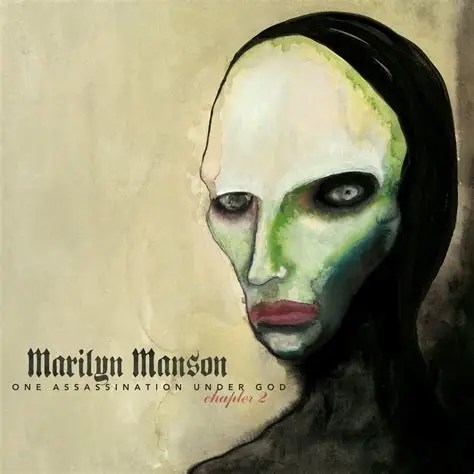
Marilyn Manson
One Assassination Under God – Chapter II
Nuclear Blast Records
Released: August 14th, 2026
Rating: 7/10
–
1 – Unalive
2 – Don’t Answer the Door
3 – Front Toward Enemy
4 – All the Vilest Things
5 – None of the Suns
6 – Lucifer’s Teardrop
7 – The Arsonist
8 – Exit Wound
9 – Enantiomorph
–
Marilyn Manson’s identity is overwhelmingly vast. His release history, arrest record, list of legal allegations, and general cultural influence of his unhinged and feral early days is widespread, deep, and full of strange surprises. Having formed in 1989, the era commonly known as Marilyn Manson and the Spooky Kids was a bad acid trip of industrialized and aggravated heavy metal. The demo period began in 1990 and ran until their major label signing in 1993, tapes such as Big Black Bus, Lunchbox, After School Special, and The Family Jams showcased the primitive and crude versions of tracks such as ‘Cake and Sodomy,’ ‘Lunchbox,’ and ‘Cyclops,’ that would later appear on their 1994 major label debut, Portrait of an American Family.
Portrait of an American Family arrived in the summer heat of 1993, where industrial had already carved its own territory on the music map, death rock had been long established, and the blend of ‘heavy industrial’ and ‘heavy metal’ was becoming more and more commonplace. Combining the elements of a multitude of dark influences, ranging from Skinny Puppy and Nitzer Ebb to Bauhaus, Alice Cooper, and David Bowie, these components were fastened and fashioned in a mechanism of audio terror that broke the boundaries of music. Marilyn Manson smashed through the wall by understanding that the artist can take on the role of a character and that appearance can be as important as the music. Marilyn Manson’s start was the culmination of the magnitude of ideas wrapped up across their early demos; purity of thought and character. It was industrialized, it was bruised, it was distressed. The stage, however, was being set. From ‘Cake and Sodomy’ forward, the band unraveled cultural, religious, and social concepts and wrapped them back together in the form of nooses. The lyrical content was confrontational, the atmosphere was uninviting to the uninitiated, and the delivery was raw and frontal. The leap from demo era to major label chaos was complete.
What came next was something…something you had to witness yourself to really understand and grasp. October of 1996 saw Antichrist Superstar, and if you were there, you remember ‘The Beautiful People’ showing up the month before on MTV and numerous public radio stations. The album was a nightmare of scathing social commentary, blatant shock, direct confrontation, and a ripping torture circus of pummeling riff crafting and well-engineered songwriting. 7 million copies would be sold worldwide, and the accompanying tour – The Dead to the World Tour – was an endurance run of abuse. Hitting 175 locations over the course of 1996 to 1997, causing an exhaustive firestorm of controversy across North and South America, Europe, Japan, and Oceania, the tour vaulted the band into a meteoric position, proving the very serious point that pop music did not have to be aesthetically comfortable.
Socially, he became one of the villains of the modern music era. It was a PR nightmare of epic proportions, and because of it, it was wildly successful. The man should be revered for his marketing skills and ability to draw critical attention to the band through frequent TV spots and interviews, which became the stuff of legend amongst young music fans teetering on the edge of the oblivion that is curiosity.
He was a household name back then. It was a weird time, socially, in the 1990s. You had insane genetic rejects like Pat Buchanan running around and declaring a “war for the soul of America.” Boomers unanimously sucked each other off under the Reagan administration, acknowledging but never acting on the blatant despoilment of contemporary pop culture that was happening in front of them.
America was heading for moral poverty. One side talked a lot; the other side ran around the planet converting hordes of watching youth to the ultimate expression and outburst of not wanting to be part of the machination of the modern American social construct and hierarchy.
That was then.
Things were solid for the band. Brian Warner became inseparable from the concept and avatar that was Marilyn Manson. The band delivered album after album of consistent, unwavering, pop-composed and industrially stylized deathly heavy metal. Members came and went, tours came and went, the band still had image and stylistic power, the music explored a battery of concepts and textures – it became familiar but uncomfortably unfamiliar at the same time.
February 1st, 2021, things derailed.
By June of 2021, Manson had a pile of lawsuits on his hands.
There was an uncomfortable and wide silence after 2020’s We Are Chaos, driven primarily by legal troubles and aggravated much further with the onset of the Covid hysteria, which took a massive shit on the music industry as a whole.
Brian Warner found himself dropped. Dropped from everyone.
Returning in 2024, on the 61st anniversary of John F. Kennedy’s head exploding, Marilyn Manson released One Assassination Under God – Chapter I through Nuclear Blast Records. If any album represented importance to one’s artistic career, this was it. It had to land. It had to cut through the noise. It had to be unmistakably Marilyn Manson. And it accomplished that.
He had changed. Both as an artist and as a person. The drugs were ditched, he slimmed down, his endurance came back, his return to the live arena was met with critical enthusiasm, driven by older legacy fans and waves of new converts.
Apanthropy covered the album, which you can check out here.
August 14th, 2026, marked the arrival of the second chapter, One Assassination Under God – Chapter II.
The return of Marilyn Manson was favorable, the follow-up album, one could debate, is of equal importance. Nine new tracks, spread across a moderate 43-minute running time, follow a similar sonic template, palette, and texture as the first chapter. Unfortunately, the strength of the songwriting wavers slightly on this newest release.
One Assassination Under God – Chapter I featured a battery of textures and deliveries. Flavors ranging from the visceral and straightforward cutting force of ‘Nod If You Understand’ and ‘Raise the Red Flag’ were offset by darker, more mellow songs such as ‘Meet Me in Purgatory’ and ‘Sacrifice of the Mass.’ The album flowed well, it paced well, it showed a concise and precise methodology to songwriting – conventional structures, unconventional tonality.
One Assassination Under God – Chapter II follows a relatively static tempo and meter. What it lacks in frontal assault and intensity, it makes up with cinematic atmosphere and death-rock prowess that charts new sonic territory in a sonically barren 2026. It’s a noticeable trade-off. It’s not necessarily a drawback; it’s up to the legacy fan or the new convert to decide whether it works for them.
Opening the record is ‘Unalive,’ and the dissociative melodies crawl forward immediately. Creating a dense and uninviting atmosphere, cinematic in a relatively glorious sense – grandiose, caliginous, and sweeping. Stark razor cuts of thundering power chords shove the choruses into the listener’s face, with more drone-heavy verses setting a tone very similar to the first chapter.
‘Don’t Answer the Door’ washes over the listener like the warmth of opiate-fueled sleep. A death-rock swagger and flair, pulsing with strobing bass and synth swells. Simplistic guitar riffs exist to accent the primary lead of the songs – the vocal track. Each particular audio track feels cold and distant, but when blended together, it creates a rich tapestry of aural detailing that requires multiple listens to explore in its entirety. Keyboard accents lurk above, below, and within each beat and measure, never overbearing, always perfectly complimentary. This is an excellent track, perhaps one of the strongest on the record.
Offering a shift in sensation, feel, and tempo is ‘Front Toward Enemy,’ the spiritual brother – musically – of ‘Nod If You Understand’ from the first chapter, it would seem. It is the first real push of aggressive action on the record, breaking away from the more mild and tempered opening tracks. Choruses hark like chaos birds, screaming chords in proto-typical progressions wrack the listener, with percussive accenting that pushes the music forward.
‘All The Vilest Things’ and ‘None of the Suns’ take the record back to an atmospheric, cinematic gothic rock approach. ‘None of the Suns’ stands out due to its cutting contrast in the form of Manson’s higher pitched vocal approach during chorus sections – bombastic, powerful, booming. 13 albums in, years and years of wear and tear on the road, and these are perhaps some of the finest vocal workings of his career.
A faster, more up-tempo track was the perfect transitional move in terms of flow, and it manifests in the form of ‘Lucifer’s Teardrop.’ Early Marilyn Manson was almost famously barbaric – stripped, cruel, in-your-face. The maturity of later Marilyn Manson in a songwriting sense is perhaps captured best here. The flow and pacing of the song remind the listener of older tracks such as ‘Deep Six’ and ‘Saturnalia.’ The extended and extensive chorus teems with gothic rock radiance and the delivery from end to end is a great way to start off the last stretch of the record. Once again, the vocal work is some of Manson’s best and to hear it this late in his career is a genuine high point.
‘The Arsonist’ is, unfortunately, entirely forgettable.
‘Exit Wound’ bleeds Ministry-style riff structures with Manson’s strangely dynamic vocal execution. It’s not the strongest track on the record but it keeps things flowing late in the record’s lifespan.
One thing Marilyn Manson has consistently done effectively, perhaps better than the vast majority of his contemporaries, is open and close a record in spectacular manner. This, however, is a rare instance where the end track is kind of disappointing. It follows the pacing and texture of several tracks that came before it, feeling too repetitive and circular for a track closing a record.
The tail end of One Assassination Under God – Chapter II is, unfortunately, quite thin and anemic. The album does suffer from some repetitive texturing and delivery, which is really the only detraction. The tonality, especially the presence of the synth work, is masterful, perhaps more atmospheric than the record that preceded it.
For a 13th album, this is powerful. In the context of a modern heavy metal release, one could perhaps criticize the lack of rancor and intensity. In the context of an atmospheric rock release with contemporary influence, this is a phenomenal record. One should keep this in mind when heading in for their first listen. If you’re expecting to get your teeth knocked out in the same manner as Antichrist Superstar or Holy Wood (In the Shadow of the Valley of Death) you’re going to be disappointed. Those looking for the spiritual sequel to chapter one, and an album that mixes the better parts of WE ARE CHAOS, Heaven Upside Down, and Born Villain together, this is it.
One Assassination Under God – Chapter II is an excellent later entry in the band’s discography and unmissably Marilyn Manson in sound, design, and delivery. Where Manson goes from here as a songwriter is a critical decision at this point in his career, especially without the likes of Tyler Bates crafting the sonic narratives now. In any order, this is a solid record for the late summer of 2026 and a mellow tapering-off point for those looking for something less abrasive to listen to as a sonic palette cleanser.
Label: Nuclear Blast Records
Band: Marilyn Manson
AJK


Leave a Reply