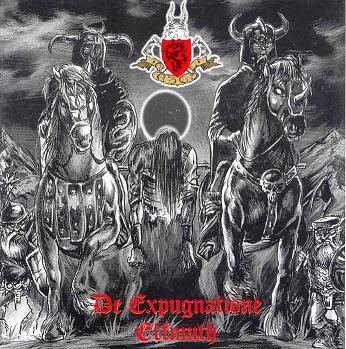
Nazgûl
De Expugnatione Elfmuth
Elegy Music
Released: 11/17/2002
–
1 – Proemium
2 – Hult-Garth (Qui Inferorum Animas Excitat)
3 – Elficidium
4 – Dies Festi…
5 – In Summis Montibus
6 – Nigrum Praesagium
7 – Impetus Quartae Lunae Novae
8 – Caelum Obscuratur
9 – Legio Draconorum Orkian
10 – Natura Cadit
11 – Charcharon (Damnosus Impetus)
12 – Solvitur ad Elfmuth (Ante Bellum)
13 – Bellum (Humanes Resistentes Superavit)
14 – Epilogus
–
The scope of black metal evolved from the primitive sonic information of the mid-to-late 1980s to become a limitless gulf of human ideas and emotion. A vast cosmos of kinetic and potential ideas, celestial bodies, each with their own unique characteristics. One such entity – the bizarre Italian duo of Thornset and Zakrathor – who perform under the moniker of Nazgûl, quietly and encased in a veil of obscurity, released a single full-length in 2002 that encapsulates the very idea of ‘symphonic black metal.’
Stitched within and throughout, down to the finest detail, is something that goes so beyond the genre concept that it becomes a freak of nature within the black metal world. Tolkien-revisionist classically composed symphonic black metal with lyrics entirely in Latin. It’s like Summoning on a mix of steroids and mushrooms. It’s an album with a niche concept where the orcs, dragons, and ogres prevail over human and elf alike. It is a brief window into a world of death and dismal destruction, a fantasy of barbarity and wrath, spun in a rich tapestry of dense keyboards played with hands that have a razor-sharp and clear understanding of classical composition and theory.
These aren’t simple motifs or single-note melodies played over top crashing guitars like some sort of studio afterthought. These are rich, dense, charismatic, and wholly formed segments of narrative music. Think of the dungeon synth construct but woven into black metal to where the integration is not only seamless, it’s evolutionary and triumphant; brash and graceful at once.
‘Proemium’ establishes something theatrically sinister right from the start. One that invokes the idolization of the villain, something ominous and wretchedly foreboding. Strings crest and break, rise and fall over top cult-like tom rhythms with stark, chanting-style vocals sung in Latin, establishing the narrative premise of the album.
‘Hult-Garth (Qui Inferorum Animas Excitat)’ swells to life and crashes like a storm at deep sea. Synth tones and strings lurch forward, and behind it comes ripping guitars and the mechanized syncopation of programmed double-bass drums. The primary ‘riff’ shows layers of instruments whipping back and forth with progressive-minded strings giving delightful animation to the thick, storming rhythm. The vocal delivery of Zakrathor ranges from a shrill bird-like call to grotesquely pitch-shifted gutturals, presenting themselves not so much as ‘vocals’ as they are individual characters or concepts.
‘Elficidium’ starts with a joyous flute melody, soaring progressive strings, and single-note tremolo that invokes the forest of the elves that are the subject of this song. Uplifting, thematic, and carefree. But the song takes an abrupt shift, musically and narratively, representing a cadre of abominations that have launched a surprise attack against the elves. Orges – churning fifth chord tremolo and bellowing horns – smash, rape, and slaughter the elves down to the last man, woman, and child.
‘Dies Festi…’ is a short interlude of celebratory feasting music, representing perhaps the ignorance and obliviousness of the humans. ‘In Summis Montibus’ sees these people slaughtered, by orc and dragon, hard-charging riffs and driving drums open the song, before a chorus of blaring horns grabs hold of the song’s direction. War horns bounce and scream as vocals proclaim the downfall of Bur-Caal. An interlude in the middle of the track sees a complete shift into battlefield motif complete with marching snare. The wail of synth horn and string bring the song back into focus and resolution.
‘Nigrum Praesagium’ is an interlude that is primarily led by a rich and complex harpsichord melody, accompanied and marrying to a variety of classical instrumentation to either harmonize the main melody or deeply accent it. This is not an amateur grasp of music theory.
‘Impetus Quartae Lunae Novae’ proclaims the downfall of Kamuth, another sinister proclamation with an extended keyboard introduction similar to that of ‘Elficidium.’ This is one of the more direct songs, like ‘In Summis Montibus.’ Closing the track is another rich and glory-invoking keyboard segment. As stated earlier in this review, this is the construct of dungeon synth, fused to black metal.
‘Caelum Obscuratur’ is another instrumental that signifies the turning point of the album, where, narratively, humanity and elven kind are on the brink of total defeat. Regal horns bellow in ‘Legio Draconorum Orkian,’ a slamming exhibition of death and destruction. One of the best songs of De Expugnatione Elfmuth. Some of the most exceptional keyboard compositions are confined within this track, from beautiful accents to full-on leading melodies, often several layered upon each other at once. This, plainly stated, is a genuinely beautiful track in terms of composition.
‘Natura Cadit’ is another separator track and an instrumental consisting once again of harpsichord and layered string and bow melodies. ‘Charcharon (Damnosus Impetus)’ is another triumphant hard-hitter like ‘In Summis Montibus,’ but with the gorgeous keyboard work of ‘Legio Draconorum Orkian,’ it invokes panic and mayhem sonically; tension and resolution, masterfully executed and meticulously crafted.
‘Solvitur ad Elfmuth (Ante Bellum)’ is darkness’ final push into the heart of Elfmuth, a great skullship packed with nefarious abominations hastily make way across the sea on a black breeze in the name of war, bloodshed, and massacre against the humans. Triumphant military-minded marching snare and accompanying horn beckon to the listener. Powerful, slamming fifth chord rhythm work drives the song forward atop pounding drums. At the 1:06 mark, is something that many bands are desperate to achieve. The sound of war. It can be interpreted in unnumerable ways. But to musically personify the concept of battle is to achieve greatness in composition. Many bands have done it, in many different ways, but for Nazgûl, there is a perverse, barbaric bravado to their interpretation. Classical sensibilities fused to modern black metal. A simple concept that has proven difficult to achieve but is certainly captured here in spectacular display.
‘Bellum (Humanes Resistentes Superavit)’ is the fall of the human resistance. The musical interpretation of Baazgor’s filthy sword smashing the skull of the final human general, bringing the album’s narrative to its conclusion. The dark perversion of Tolkien’s work is complete.
Concluding the recording is ‘Epilogus,’ a medieval march into the obscurity of history.
Production on De Expugnatione Elfmuth is reflective of the early 2000’s which bore the album. The drum machine is a bit awkward at times, and the guitars are a touch low. It would have been supremely interesting to have heard the album recorded in the same textural manner as their 1998 demo, Omne Est Paratum, which was generally much more rigid and reverb-intensive, more reflective of early 2000’s traditional black metal. Regardless of some of the production shortcomings – if they can even be called that – the end result is still an epic display of destruction and war.
This one and only release from Nazgûl is unparalleled in terms of compositional quality. While the riff crafting may not be loaded with technicality and rancor, its accompanying principle quality in tandem with the brilliant keyboard work is unmatched to this day.
This is genuine ‘lightning in a bottle’ from the Italian black metal scene and a mandatory listen for anyone who hasn’t experienced this record. Obscure it may be, but it’s an unsung hero of the symphonic black metal canon. From the wild, multi-faceted vocals to the gorgeous and fruitful keyboard work, to the arrangements that personify and iconify war and death at a scale not regularly heard, Nazgûl outdid themselves and their peers with this insane concept album.
AJK
 apanthropy
Leave a comment